When Will It Be Warm Again Boston
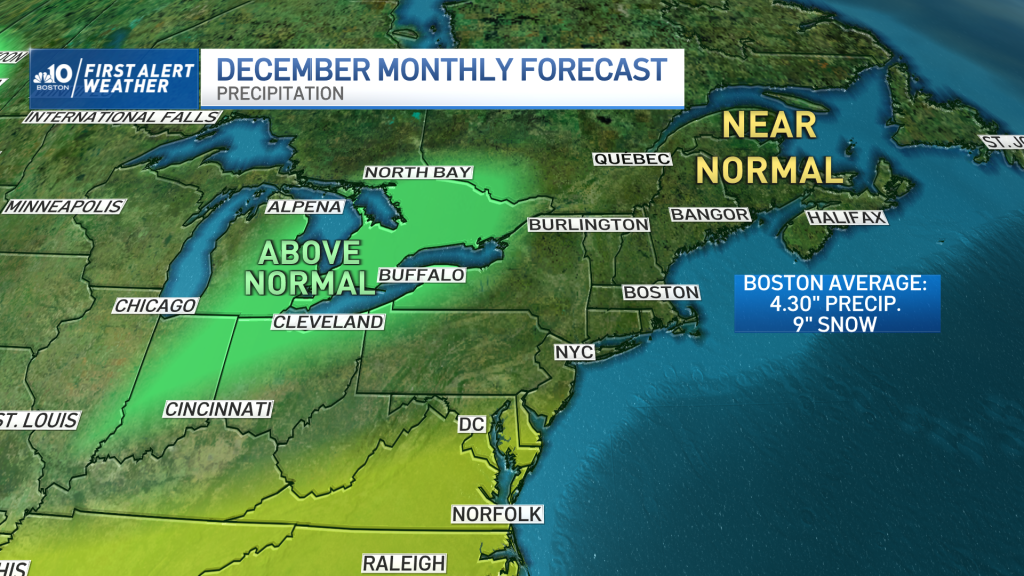
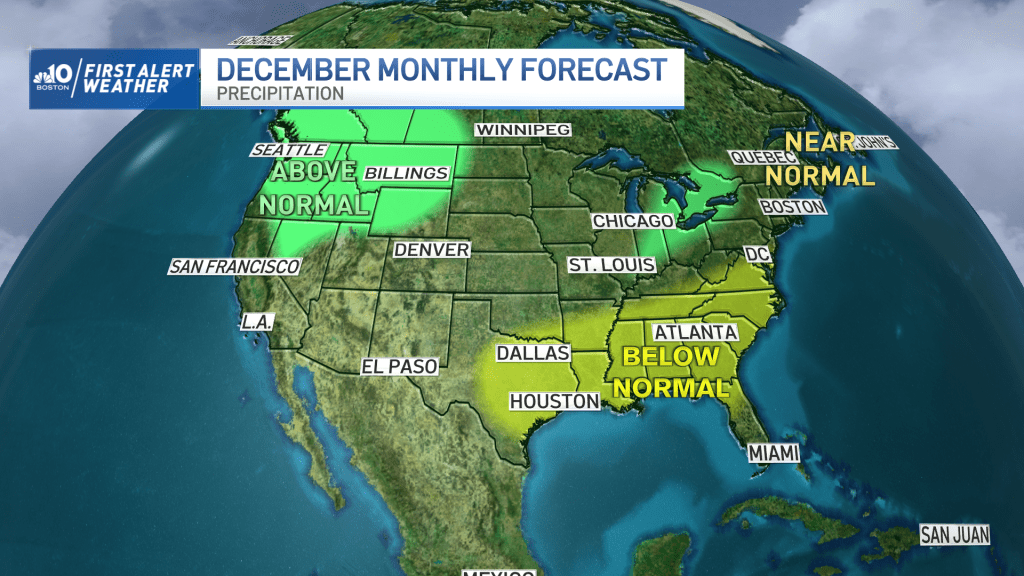
The first weekday of each month, our viewers and readers know to count on our WeatheRate Certified Most Authentic in Boston Start Alert Weather Squad for a wait at the month ahead.
The first mean solar day of Dec, notwithstanding, finds u.s.a. not but at the start of a new calendar month but likewise the beginning of a new flavour. The calendar may not show astronomical winter until the Wintertime Solstice on Tuesday, Dec. 21, at 10:59 a.m., just meteorological winter starts on Dec. 1, and our meteorologists take plenty of thoughts on the flavour alee.
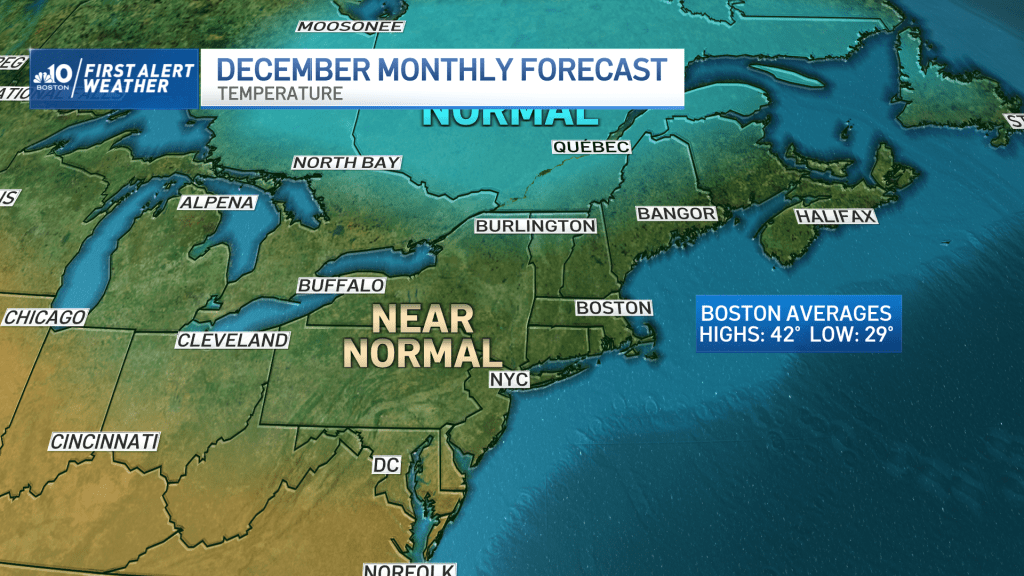
First, some perspective: after three months of warmer than normal temperatures in the Boston expanse, November's average temperature came in precisely at normal – 44.7 degrees. Precipitation was below normal by a wide margin, with only one.34 inches, compared to the normal value of three.66 inches, with no observed snowfall falling, which is shy of the normal of 0.7 inches in Boston.
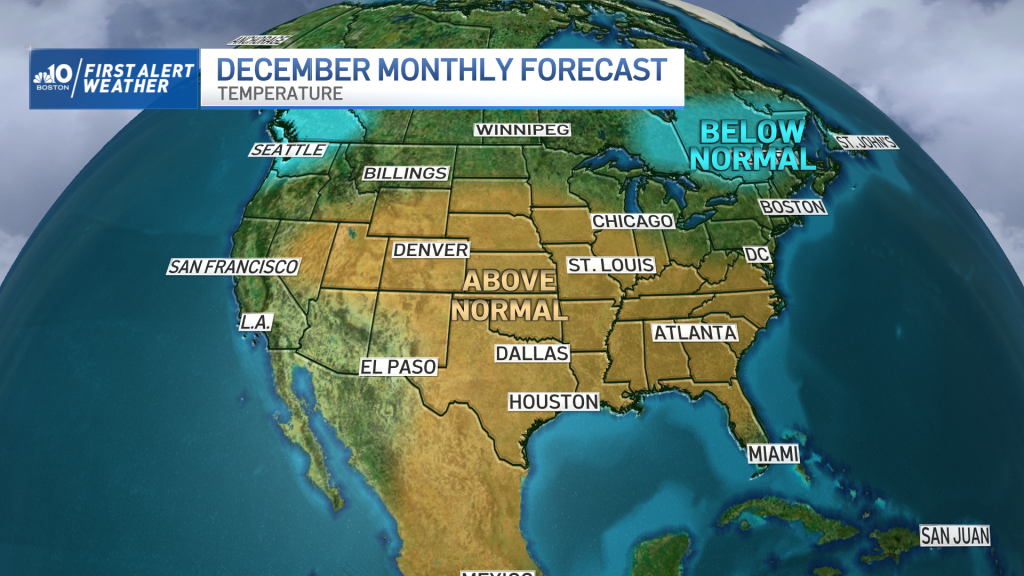
On a bigger film, near of the United States has been warmer than normal for several months and nosotros don't look that to change. December likely will find most of the country warmer-than-normal, although what's true for the country doesn't always hold true for New England. The latter half of November has shown an increasing amount of common cold air in Alaska, and this common cold has shown a tendency of dropping into Quebec – a design doesn't look to stop. The big driver in this weather pattern has been a recurring, strong, stalled upper level storm (a jet stream trough) over the Norwegian Bounding main and Barents Sea in Northern Europe. With this characteristic not breaking, the jet stream across the Northern Hemisphere has fallen in lock-step and doesn't appear to be budging soon.
The result over the final few weeks – and likely through December – is a steady feed of storms off the Pacific Ocean into the northwestern corner of the United States, running east beyond the Great Lakes and redeveloping well-nigh the Northeastern Seaboard.
Looking a month ahead is i thing – looking an entire flavor ahead is more involved.
Local
In-depth news coverage of the Greater Boston Area.
Meteorologist Pamela Gardner has been keeping a close centre on Pacific Ocean water temperatures: "La Niña has strengthened in the terminal few weeks. This means colder than normal sea surface temperatures. Its counterpart is El Niño, which is warmer than normal sea surface temperatures. With La Niña, nosotros typically see colder and wetter atmospheric condition in the northeast during the winter months."
Pamela's not alone is watching the contrary ocean – meteorologist David Bagley keys in on the same signals from nature: "We can't discount this year's La Niña, which may drive the jet stream further n, simply a dip in the jet stream out of the Bully Lakes from time to time with extremely cold air spilling over may exist all we need to allow for some Clipper-type systems starving for attending as they swoop out of the Lakes region and into the Atlantic south of New England and potentially develop into snow makers."
Meteorologist Pete Bouchard has been forecasting New England atmospheric condition for decades, and he's seen seasonal forecasts pan out -- and miss the marking. Pete reflects the sentiment of our entire weather team: "I'm not a huge fan of seasonal (read: winter) forecasts. That said, I know people love them and I'1000 happy to oblige. So, permit me requite you my two cents: prepare for the warm/cold extremes with a hard lean toward the warm at times and a slightly above normal snow. I'grand hedging my bets that snowstorms volition all overachieve, with a couple of 1-plus footers in there for skilful mensurate. In essence, information technology should be like all our past winters of late (minus 2015, of form), and a slow warmup in the spring…which may be when we really get rolling in the deep (snowfall)."
There'southward certainly plenty of evidence to support Pete's outlook of spring snow – in fact, climate change has altered modernistic winters in the northeast to make "bookend snowfall" – at the kickoff and end of wintertime – more commonplace than 20 or 30 years ago, with spring becoming a focus for snow in a warming climate.
How has climate change altered the winter design? For generations, a mass of cold air referred to in meteorology equally the "Polar Vortex" resided in high latitudes, bottling up some of the coldest air on earth during the winter months. On occasion, the Polar Vortex would wobble or dip south, thrusting a mass of cold southward for arctic outbreaks.
Yous might retrieve hearing lots virtually the Polar Vortex and extreme cold in the Northern U.s. dorsum in the winter of 2013-14. What's interesting is that wasn't the Polar Vortex of old – instead, the abundance of warmth in northern areas and around the North Pole has caused the Polar Vortex to break into pieces – unstable, wobbling bundles of cold that oft break into two or three discernible, smaller chunks rather than ane solid mass. While this tin can mean bouts of intense and abnormal common cold for those nether each piece of the Polar Vortex, the very nature of these smaller, wobbling masses is proof positive that a warming climate has inverse our winters.
So what nosotros discover in winters of late is persistent bands of heavy snowfall occurring on the edges of these meandering, relatively small masses of intense cold air. One perfect case of the impact of falling under these heavy snow bands is our southern New England winter of 2014-15, where the seasonal snow for someplace like Boston was shattered in a mere two months: "Nosotros had 60s recorded on Christmas Day... and then the snowfall blitz from Jan to February when Boston had 99.1 inches of snow, and over 110 inches of snow for the unabridged wintertime," recalls Pamela. This crush of snow unfolded as abundant warmth fought to scour out shrinking common cold.
This leaves the stakes high in a seasonal forecast: nail the band of heavy snowfall and you lot've nailed the wintertime forecast. If you set up north of information technology, you may end up colder-than-normal and drier-than-normal, while south of it, the abundant warmth of the Northern Hemisphere rules with limited snow and higher up-normal temperatures.
So when you put together our First Alert Squad forecast for winter 2021-22, what you're seeing here is an understanding between united states of america that we very well may be well-nigh one such heavy snow band this twelvemonth. The chances of something similar February/March of 2015 setting upwardly over Boston again are very express, but this team forecast shows the door is open for the northeast to meet plenty of snow.
Whether the centrality of heaviest snowfall sets up in Ski Country of northern New England, across southern New England or from New York and Pennsylvania to New Jersey will hinge on exactly how firmly cold air over Quebec holds confronting the agile northern U.Southward. storm blueprint, just our squad believes that'southward close enough to bet on a near or slightly snowier winter than normal for much of New England.
Taking it a step farther, the implication is for many events to be characterized by the greatest opportunity for snowfall at the beginning of storms, particularly in southern New England, with the abundant available warmth in the rest of the country eager to make inroads and modify snow to a mix or rain, with the longest duration of snow constitute the farther northward one is. Ofttimes, storms like this can driblet heavy snowfall rates in the first several hours, and then taper markedly thereafter, making for blitzes of plowing rather than multiple marathons.
That said, there is one other authentication of modern fall, winter and spring. On the cusp of the migrating, wobbling clusters of deep cold, we occasionally encounter slow, large, potent storms – our recent October nor'easter was a classic example of this. They are few and far between, merely a steadily rise body of water-level has ensured such storms have a harsh impact with regard to littoral flooding
Combining all of these factors, our NBC10 Boston, Telemundo Nueva Inglaterra and NECN First Alert Weather Team expects warmer-than-normal temperatures when averaged over the December/January/February timeframe (except perchance for extreme northern New England near the border with Canada), above-normal precipitation for most of the states and near to slightly to a higher place normal snowfall for the Boston expanse, with an even better chance of higher up-normal snowfall in cardinal and northern New England, including ski and snowmobile country.
galleghanpailtaild.blogspot.com
Source: https://www.nbcboston.com/news/local/how-much-snow-will-we-get-your-2021-22-new-england-winter-forecast/2579580/
0 Response to "When Will It Be Warm Again Boston"
Post a Comment