Why Do You Think the Spanish Felt the Need to Destroy So Much of the Native Arts of the Americas?
The Spanish missions in the Americas were Catholic missions established by the Spanish Empire during the 16th to 19th centuries in the period of the Castilian colonization of the Americas. These missions were scattered throughout the entirety of the Castilian colonies, which extended from Mexico and southwestern portions of the current-day United States to Argentina and Chile.
The relationship between Spanish colonization and the Catholicization of the Americas is inextricable. The conversion of the region was viewed every bit crucial for colonization. The missions created by members of Catholic orders were oftentimes located on the outermost borders of the colonies. The missions facilitated the expansion of the Spanish empire through the religious conversion of the ethnic peoples occupying those areas. While the Spanish crown dominated the political, economic, and social realms of the Americas and people indigenous to the region, the Catholic Church dominated the religious and spiritual realm.
The Catholic Church building as an establishment was interested in redeeming the souls of the indigenous Americans. They believed that they were given the divine correct and responsibleness of Christianizing equally many parts of the world equally possible. Missionaries themselves were motivated by the want to construct the Americas as the site of pure Christianity. Many clergy ventured to the Americas to preach what they felt was a purer form of Christianity, and to redeem the souls of the indigenous peoples.
History [edit]
Patronato Real [edit]
The Patronato Existent, or Purple Patronage, was a series of papal bulls constructed in the 15th and early 16th Century that gear up the secular relationship betwixt the Spanish Crown and the Catholic Church, effectively pronouncing the Spanish King'due south control over the Church in the Americas. It clarified the Crown's responsibility to promote the conversion of the ethnic Americans to Catholicism, besides as total potency over the Church, educational, and charitable institutions. It authorized the Crown'south command over the Church's tithe income, the taxation levied on agricultural output and livestock, and the sustenance of the ecclesiastical hierarchies, physical facilities, and activities. Information technology provided the Crown with the right to corroborate or veto Papal dispatches to the Americas, to ensure their adherence to the Patronato Existent. It determined the founding of churches, convents, hospitals, and schools, too equally the appointment and payment of secular clergy.[one]
It is clear that the Patronato Real provided the Spanish Crown with an unprecedented level of authority over the Catholic Church. It demonstrates the intricate human relationship the political expansion of the colonies had with Catholicism. As these bulls were discussed and granted prior to and in the early on stages of Spanish Colonization, it is articulate that the Cosmic Church operated in the interests of the Spanish Crown from the start. The expansion of Cosmic missions around the Americas afforded the Crown an increasing income from the levied taxes and control over tithe income. That economic interest—forth with the Crown'south command over the Church building'south educational and charitable institutions, which directly interacted with and deeply influenced a large swath of the indigenous populations they were colonizing—provided an statement for the Crown's interest in incorporating the Cosmic Church building into their colonization of the Americas.
Franciscans [edit]
Franciscan missionaries were the first to arrive in New Kingdom of spain, in 1523, following the Cortes expeditions in United mexican states, and soon afterward began establishing missions across the continents.[2] [3] The Franciscan missionaries were split evenly and sent to Mexico, Texcoco, and Tlaxcala.[iv] : 138 In addition to their primary goal of spreading Christianity, the missionaries studied the native languages, taught children to read and write, and taught adults trades such as carpentry and ceramics.
Pedro de Gante was a Flemish Franciscan missionary who desired assimilation of Native American communities to further educational discourse amongst ethnic communities. He was then influential in his piece of work, he became known every bit "The commencement teacher of the Americas".[5] Originally, Peeter Van der Moere, Pedro de Gante, came to New Kingdom of spain, in 1523 also known as Mexico. A missionary, Pedro de Gante, wanted to spread the Christian faith to his native brothers and sisters. During this time, the mentality of the Spanish people proscribed empowering the indigenous people with knowledge, because they believed that would motivate them to retaliate against the Spanish rulers. Nevertheless, Pedro de Gante saw the ritualistic practices of the ethnic, which traditionally involved human sacrifices (particularly from enemy tribes), and as a missionary, saw the need for a change in faith. He decided the best approach was to adapt to their mode of life. He learned their language and participated in their conversations and games.[6] Despite having a stutter, he was a successful translator of Nahuatl and Spanish.[5] Additionally, Pedro de Gante was a large advocate of education of the youth, where he established schools throughout United mexican states to cater to the indigenous communities.[seven] His influence spanned so broad, others like him followed by example. Of the futurity missionaries to come to America, at least 3 of his compatriots came.[viii]

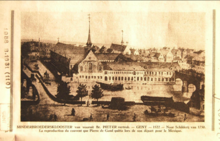
Pedro de Gante living quarters before expedition.
Past 1532, approximately 5,000 native children were educated by the Franciscan missionaries in newly built monasteries spread throughout central Mexico. Many of these children resided in cities such equally Cholula, Tlalmanalco, Texcoco, Huejotzingo, Tepeaca, Cuautitlán, Tula, Cuernavaca, Coyoacán, Tlaxcala and Acapistla. Pedro De Gante was recorded to have the largest grade of approximately 600 natives in United mexican states City.[four] : 146 The kickoff missionaries to arrive in the New Globe were Franciscan friars from the observant faction, which believed in a strict and limited practice of religion. Because the friars believed teaching and practicing can only be done through "meditation and contemplation," Franciscans were not able to convert as many people every bit rapidly as the Castilian wanted. This caused strain between colonial governments and Franciscan friars, which somewhen led to several friars fleeing to nowadays day western Mexico and the dissolution of Franciscan parishes. Other bug likewise contributed to the dissolution of Franciscan parishes, including the vow of poverty and accusations from colonial governments. However, Spanish missions often used money from the King to fund missions. Having friars taking coin was controversial within the church. In addition, the colonial government claimed missionaries were mistreating indigenous people working on the missions. On the other mitt, the Franciscan missionaries claimed that the Spanish government enslaved and mistreated indigenous people. Present day efforts are to evidence where Franciscan missionaries protected the ethnic people from Spanish cruelties and supported empowering the native peoples.[9]
Jesuits [edit]
The Jesuits had a wide-spread bear upon from their inflow in the New World about 1570 until their expulsion in 1767. The Jesuits, especially in the southeastern part of Due south America, followed a widespread Spanish practice of creating settlements called "reductions" to concentrate the widespread native populations in order to better rule, Christianize, and protect the native populace.[10] The Jesuit Reductions were socialist societies in which each family had a firm and field, and individuals were clothed and fed in render for work. Additionally, the communities included schools, churches, and hospitals, and native leaders and governing councils overseen past two Jesuit missionaries in each reduction. Similar the Franciscans, the Jesuit missionaries learned the local languages and trained the adults in European methods of construction, manufacturing, and, to a sure extent, agronomics.[11] By 1732, there were thirty villages populated by approximately 140,000 Indians located from Northern Mexico down to Paraguay.[12] Castilian settlers were prohibited from living or working in reductions. This led to a strained relationship betwixt Jesuit missionaries and the Spanish because in surrounding Spanish settlements people were non guaranteed nutrient, shelter, and wear.[13]
Another major Jesuit effort was that of Eusebio Kino S.J., in the region then known every bit the Pimería Alta – mod-24-hour interval Sonora in Mexico and southern Arizona in the U.s..[xiv]
Dominicans [edit]
The Dominicans were centralized in the Caribbean and United mexican states and, despite a much smaller representation in the Americas, had one of the most notable histories of native rights activism. Bartolomé de las Casas was the showtime Dominican bishop in Mexico and played a pivotal role in dismantling the practice of "encomenderos", these laws were intended to prevent the exploitation and mistreatment of the indigenous peoples of the Americas by the encomenderos, past strictly limiting their power and dominion over groups of natives, with the establishment of the New Laws in 1542.[15]
Parish expansion [edit]
To promote conversions, the Catholic Missionaries in the Americas received Regal approval to create provinces, or parishes. These parishes echoed the structures of European towns—created with the explicit intention of converting the indigenous peoples who constructed and lived in them. These territories were split from the jurisdictions of the Crown, with carve up laws and structures. The papacy sent multiple religious orders to set towns in areas along the borderlands[16] to prevent a single order from condign too powerful. First the Franciscans gear up upward parishes, and then the Dominicans, Augustinians, and Jesuits followed. These orders are discussed in more detail previously in this article.
To begin the process of constructing a new parish, the priests entered an indigenous village and outset converted the leaders and nobles, called caciques. These conversions were often public. In one case the caciques were converted, the clergy collaborated with the elites to construct a chapel, ofttimes atop the destroyed temple for the indigenous spirituality. This chapel played a office in bringing the rest of the people of the town to the Church. The Franciscans in item wanted an indigenous priesthood, and built schools to teach indigenous aristocracy about humanistic studies.
The clergy were near interested in converting the souls of the indigenous, past any ways possible. Therefore, in many instances, the clergy used ethnic religions to proceeds trust and legitimacy. In fact, many members of the clergy learned indigenous languages so they could be more accessible and understandable to those wanted to convert. They even selected ethnic languages to be used as lingua franca in areas that had linguistic diversity. In New Spain, which is modern-twenty-four hours Mexico and Primal America, the friars taught Nahuatl to ethnic Americans who had non spoken it prior, as a fashion of establishing a common language. They translated hymns, prayers, and religious texts into Nahuatl to make Catholicism more widely spread and understood. The clergy in Peru used Quechua and Aymara in similar ways.[1]
Early into the beingness of the community, the European clergy formed a cofradía, which is a lay brotherhood meant to raise funds to construct and support the parish church building, provide aid to the poor, anile, or infirmed and to widows and orphans, and to organize religious processions and festivals for Catholic holidays.[17] That said, the cosmos of the parish as well depended on the labor of the recently converted indigenous people to build schools, offices, houses, and other infrastructure for economical production. This need for labor led to conflict with the encomenderos, who were charged past the Crown with the exclusive task of exploiting indigenous labor.
Parish economy [edit]
The Catholic orders profited tremendously from the expansion of the parishes and from the conversion of the indigenous peoples, along with the exploitation of their labor. The Jesuits, among other orders, became extremely wealthy every bit a consequence. The Jesuits gained landholdings in the 17th century, becoming prominent property owners throughout the colonies. Unlike other methods used for property accumulation, like state seizure or royal grant, the Jesuits gained belongings from purchase and donation. The Jesuits also clustered wealth from tithes and clerical fees, also as from profits fabricated from the production of agricultural and other commercial products. The Jesuits, along with the other religious orders, fully participated in and profited off of the internal trade economic system of the Americas.[1]
Therefore, the religious orders that had vowed themselves to poverty had become some of the wealthiest institutions in the Americas. All of this production was at the expense of the indigenous who were converted and colonized, as it was the ethnic people who completed the labor-based tasks. As nosotros tin see, the spread of Catholicism was highly profitable to the Catholic Church.
Native revolts [edit]
In addition to the encomienda system, the aggressive implementation of missions and their forcible institution of reductions and congregations led to resistance and sometimes revolt in the native populations being colonized. Many natives agreed to bring together the reductions and congregations out of fearfulness, only many were initially still immune to quietly continue some of their religious practices. However, equally treatment of natives grew worse and suppression of native customs increased, then did the resistance of the natives.
The most notable example of rebellion against colonization is the Pueblo Revolt in 1680, in which the Zuni, Hopi, besides as Tiwa, Tewa, Towa, Tano, and Keres-speaking Pueblos took command of Santa Fe and drove the Castilian colonial presence out of New Mexico with heavy casualties on the Castilian side, including 21 of the 33 Franciscan missionaries in New Mexico. The region remained autonomous under native command despite multiple not-trigger-happy attempts at peace treaties and merchandise agreements until 1692.
The Tepehuan Revolt was likewise stirred by hostilities against the missionaries, which arose due to the concurrent and explosive rising in disease that accompanied their arrival.[18] The Tepehuan associated the rise in decease directly with these missionaries and their reductions, which spread illness and facilitated exploitative labor to encomanderos and miners.[xix] The defection lasted from 1616 to 1620 with heavy casualties on both sides. During the conflict, the Spanish abandoned their policy of "peace by purchase (tribute)" in favor of "war of burn down and blood."[xx]
Epidemics in missions [edit]
With resistance and revolts, the native population dropped drastically with the introduction of Spanish missions. However, the main factor for the overwhelming losses were due to epidemics in the missions. Despite being affected before the introduction of missions, the buildings allowed rodents to infiltrate living areas and spread illness more rapidly. Some of the about common diseases were typhus, measles and smallpox.[21] Many natives were living in cramped spaces with poor hygiene and poor nutrition. This led not just to high mortality charge per unit, but to low fertility rates as well. In specific areas where natives were dispersed in various regions, friars created new villages to divide the natives from Europeans and simultaneously systemize their teachings.[22] It is estimated that every 20 years or so, a new epidemic wiped out the adult population of natives in many missions, giving no gamble for recovery.[23] It is imperative, at this moment, to illustrate the loss of life in the Native population by using the example of the modest province known as Jemez in New United mexican states. Scientists say that upon the arrival of the Castilian missionaries in 1541, approximately five,000 to 8,000 natives lived in Jemez. Through examination of plants within the village, scientists were able to determine the age gap of plant life to better understand the loss of human interaction with vegetation. By 1680, scientists concluded that the Jemez village was populated by approximately 850 natives. This 87% decrease in population size illustrates the tragic effects of diseases of the time, combined with the introduction of a new culture influenced by the Spanish missionaries.[21]
Futurity United States territory [edit]
The first African Catholic slaves that arrived in what would eventually go the United states of america primarily came nether the Spanish flag. Esteban, an African Catholic enslaved by Spaniards, was among the beginning European grouping to enter the region in 1528, via what would become Florida. He would go on to serve on various other North American expeditions.[24]
As early on every bit the 17th century, Spanish Florida acted every bit a haven for fugitive slaves from the Southern colonies. The Spanish colonial regime in Florida freed slaves who reached their territory if they converted to Roman Catholicism. Virtually such freedmen settled in the St. Augustine surface area at Gracia Existent de Santa Teresa de Mose (Fort Mose), the first settlement of former slaves in N America.[25]
Spain also settled the California region with a number of African and mulatto Catholics, including at least ten of the recently re-discovered Los Pobladores, the founders of Los Angeles in 1781.[26]
Practices [edit]
Catholic missions were installed throughout the Americas in an endeavour to integrate native populations as role of the Spanish culture; from the point of view of the Monarchy, naturals of America were seen as Crown subjects in need of care, pedagogy and protection from the war machine and settlers, many of which were in the pursuit of wealth, state and dignity titles. The missionaries goal was to convert natives to Christianity, because diffusion of Christianity was accounted to exist a requirement of the religion. Spanish Vice-royalties in America had the aforementioned structure as the Vice-Royalties in Spanish provinces. The Catholic church depended on the Kings administratively, but in doctrine was subjected, equally always, to Rome. Spain had a long battle with the Moors, and Catholicism was an important factor unifying the Spaniards against the Muslims. Further, the religious practices of American natives alarmed the Spanish, so they banned and prosecuted those practices. The role of missionaries was primarily to supercede indigenous religions with Christianity, which facilitated integration of the native populations into the Spanish colonial societies.[27] One symbolic instance of this was the practice of constructing churches and cathedrals, such every bit Santa Domingo and Cathedral Basilica of Our Lady of the Assumption, on top of demolished native temples.[28] Establishment of missions was oftentimes followed by the implementation of Encomienda systems by the Vice-imperial government, which forced native labor onto land granted to Europeans by the Spanish Crown and led to oppression.
Paternalist protection [edit]
Much of the expressed goals of the spread of Catholicism was to bring conservancy to the souls of the indigenous peoples. The Church and the Crown alike viewed the role and presence of the Church in the Americas every bit a buffer confronting the corrupt encomenderos and other European settlers. The Church and its clergy were meant to be advocates for the interests of the indigenous, equally well as to provide them with social services. To do this, the indigenous parishes had different laws, different economies, dissimilar authorities styles, all with the intention of keeping them separate, and protected from the European society. The ethnic Americans were considered by the Crown and the Church to be legal minors, so much of the motivation for this paternalism comes from the want of the Church to protect their "children" from the harsh and corrupt Europeans.[ane]
Cultural changes [edit]
In converting natives, missionaries had to find various ways of implementing sacramental practices among them. Some sacraments, like Baptism, were already similar to the Nahuatl rituals during birth, ordinarily performed by a midwife. Many missionaries fifty-fifty allowed for natives to go along some aspects of their original ritual in identify, like giving the child or newborn a small arrowhead or broom to stand for their future roles in gild, equally long as information technology complied with Catholic beliefs. Other sacraments, similar Matrimony, were fairly different from native practices. Many natives were polygamous. To perform the sacrament of union, Franciscan friars had a hubby bring his many wives to the church, and had each state her reasons for being the 1 true married woman. The friars then decided who was the wife, and performed the sacrament.[29]
In improver to religious changes, Castilian missionaries also brought most secular changes. With each generation of natives, there was a gradual shift in what they ate, wore and how the economy within the missions worked. Therefore, the younger generation of natives were the most imperative in the eyes of the Spanish mission. The missionaries began educating the native youth by separating the children from their families and placing them in Christian-based schooling systems. To reach their audition, the Spanish missionaries devoted much time to learning the native civilization. This cultural shift tin can best be seen in the very first trilingual lexicon dating back to 1540 in Mexico. This book that was uncovered took the printed version of author Antonio Nebrija's dictionary titled Grammar and Dictionary (focused on castilian and Latin translations), and added handwritten translations of Nahuatl linguistic communication within the document. Although the author of these edits is unknown, it is a tangible example of how Spanish missionaries began the process of cosmic transformation in Native territories.[30] Missionaries introduced adobe mode houses for nomadic natives and domesticated animals for meat rather than wild game. The Spanish colonists also brought more foods and plants from Europe and South American to regions that initially had no contact with nations in that location. Natives began to apparel in European-style wear and adopted the Castilian language, oftentimes morphing it with Nahuatl and other native languages.[31]
Encounter also [edit]
- Alta California
- Cerro de la Sal, Franciscan missions in the Peruvian Amazon.
- Franciscan missions to the Maya
- Louisiana (New Spain)
- Santa Rosa de Ocopa, Republic of peru
- Spanish Florida
References [edit]
- ^ a b c d Burkholder, Mark A., 1943- (2019). Colonial Latin America. Johnson, Lyman L. (Tenth ed.). New York. ISBN978-0-19-064240-2. OCLC 1015274908.
{{cite book}}: CS1 maint: multiple names: authors list (link) - ^ Page, Melvin Due east (2003). Colonialism : an international social, cultural, and political encyclopedia. Sonnenburg, Penny 1000. Santa Barbara, Calif.: ABC-CLIO. p. 418. ISBN978-1576073353. OCLC 53177965.
- ^ Higham, Carol L. (9 May 2016). "Christian Missions to American Indians". Oxford Enquiry Encyclopedia of American History. doi:10.1093/acrefore/9780199329175.013.323. ISBN9780199329175.
- ^ a b Morales, Francisco (2008). "The Native Encounter with Christianity: Franciscans and Nahuas in Sixteenth-Century United mexican states". The Americas. 65 (2): 137–159. doi:10.1353/tam.0.0033. JSTOR 25488103. S2CID 201769342.
- ^ a b L. Campos. Gante, Pedro De. Detroit: Gale, 2007, 89.
- ^ Lipp, Solomon. Lessons Learned from Pedro de Gante. American Association of Teachers of Spanish and Portuguese. Hispania, 1947, 194.
- ^ The Editors of Encyclopædia Britannica. Pedro de Gante. Encyclopædia Britannica, Inc., 1998.
- ^ Proano, Agustin Moreno. The Influence of Pedro de Gante on South American Civilisation. Artes de Mexico: Margarita de Orellana, 1972.
- ^ Schwaller, John F. (October 2016). "Franciscan Spirituality and Mission in New Spain, 1524–1599: Conflict Beneath the Sycamore Tree (Luke 19:1–ten) by Steven E. Turley (review)". The Americas. 73 (four): 520–522. doi:10.1017/tam.2016.85.
- ^ Caraman, Philip (1976), The lost paradise: the Jesuit Republic in South America, New York: Seabury Press.
- ^ "Cosmic ENCYCLOPEDIA: Reductions of Paraguay". world wide web.newadvent.org . Retrieved 27 July 2018.
- ^ Burkholder, Mark A., and Lyman Fifty. Johnson. Colonial Latin America. 9th ed., Oxford University Printing, 2014. Colonial Latin America. pg. 109
- ^ "Bartolome de Las Casas | Biography, Quotes, & Significance". Encyclopedia Britannica . Retrieved three November 2017.
- ^ Whitaker, Arthur P. (1982). "Rim of Christendom: A Biography of Eusebio Francisco Kino, Pacific Coast Pioneer Herbert Eugene Bolton Eusebio Francisco Kino". Pacific Historical Review. 6 (4): 381–383. doi:10.2307/3633889. ISSN 0030-8684. JSTOR 3633889.
- ^ "Bartolome de Las Casas | Biography, Quotes, & Significance". Encyclopedia Britannica . Retrieved xx October 2017.
- ^ Hämäläinen, Pekka; Truett, Samuel (2011). "On Borderlands". Journal of American History. 98 (2): 9–30. doi:10.1093/jahist/jar259.
- ^ McAlister, Lyle (1984). "Instruments of Colonization: The Castilian Municipio". Spain and Portugal in the New Globe, 1492-1700: 133–152.
- ^ May), Gradie, Charlotte M. (Charlotte (2000). The Tepehuan Revolt of 1616 : militarism, evangelism and colonialism in seventeenth century Nueva Vizcaya. Table salt Lake City: University of Utah Printing. p. 26. ISBN978-0874806229. OCLC 44964404.
- ^ May), Gradie, Charlotte Thou. (Charlotte (2000). The Tepehuan Revolt of 1616 : militarism, evangelism and colonialism in seventeenth century Nueva Vizcaya. Salt Lake Urban center: University of Utah Press. p. 121. ISBN978-0874806229. OCLC 44964404.
- ^ Powell, Phillip W. (1952). Soldiers, Indians, and Silver: The Due north Advance of New Espana, 1550–1600. Berkeley: Academy of California Printing.
- ^ a b Wade, Lizzie. "New Mexico's American Indian population crashed 100 years after Europeans arrived." ScienceMag, 25 Jan. 2016, https://www.sciencemag.org/news/2016/01/new-mexicos-american-indian-population-crashed-100-years-after-europeans-arrived. Accessed 14 Jan. 2020.
- ^ Burkholder, Mark A., and Lyman Fifty. Johnson. Colonial Latin America. 9th ed., Oxford Academy Press, 2014. Colonial Latin America. pg. 106
- ^ Newson, Linda. "The Demographic Impact of Colonization." The Cambridge Economic History of Latin America. Vol. 1. Cambridge: Cambridge Upward, 2005.
- ^ January xv, Dennis Herrick |; 2019 (15 Jan 2019). "The Escaped Slave Who Discovered America | Essay". Zócalo Public Square . Retrieved 12 October 2020.
{{cite web}}: CS1 maint: numeric names: authors list (link) - ^ "Forget what you know virtually 1619, historians say. Slavery began a half-century before Jamestown". usatoday.com . Retrieved 12 October 2020.
- ^ "History". County OF LOS ANGELES. 2 December 2016. Retrieved 12 October 2020.
- ^ story "History of Spanish Colonial Missions | Mission Initiative". missions.arizona.edu . Retrieved 27 October 2017.
- ^ "Cathedral of Cusco Metropolis". www.qosqo.com . Retrieved 27 Oct 2017.
- ^ Reilly, Penelope. The Monk and the Mariposa: Franciscan Acculturation in United mexican states 1520–1550(2016).
- ^ "Christianizing the Nahua." The Aztecs and the Making of Colonial Mexico, https://publications.newberry.org/aztecs/section_3_home.html. Accessed xiv Jan. 2020.
- ^ Jackson, Robert H., and Edward D. Castillo. Indians, Franciscans, and Spanish Colonization : The Touch of the Mission System on California Indians. 1st ed. Albuquerque: U of New Mexico, 1995.
- Logan Wagner, East. The Continuity of Sacred Urban Open Space: Facilitating the Indian Conversion to Catholicism in Mesoamerica. Austin: Organized religion and the Arts, 2014.
- Yunes Vincke, E. "Books and Codices. Transculturation, Language Dissemination and Education in the Works of Friar Pedro De Gante." Doctoral Thesis (2015): Doctoral Thesis, UCL (University College London). Spider web.
galleghanpailtaild.blogspot.com
Source: https://en.wikipedia.org/wiki/Spanish_missions_in_the_Americas
0 Response to "Why Do You Think the Spanish Felt the Need to Destroy So Much of the Native Arts of the Americas?"
Post a Comment